
Infrastructure I built for my own research and then cleaned up enough to hand to someone else.
slurm-receipt
A CLI that turns SLURM job history into a report of what your compute actually cost — in dollars, energy, and cloud-equivalent terms. Cluster time feels free when you are not paying the bill directly, which is exactly how people end up burning a node-week on a job that needed an hour.
agentic-research-toolkit
Portable agentic research workflows, written as SKILL.md files. The design goal is discovery over confirmation: the workflows are built to look for evidence against the hypothesis you started with, since a research agent that only confirms is worse than no agent.
sapelo2-boilerplate
A Sapelo2-specific reference, kept as a 2024 snapshot for anyone working on UGA’s HPC cluster. It is everything I kept re-deriving: ready-to-run sbatch recipes for eight tools (AlphaFold, BUSCO, MCScanX, nf-core/rnaseq, OrthoFinder, SpeedPPI, Trinotate, omega), Snakemake pipelines, CPU-plus-conda and single-GPU templates, and a Claude Code ruleset tuned for the cluster — login versus compute nodes, filesystem quotas, why source activate and not conda activate, right-sizing GPUs, post-submission health checks, each rule documenting the failure that produced it. For the cluster-agnostic version of that agent tooling, see the agentic-research-toolkit above.
Biosecurity Atlas
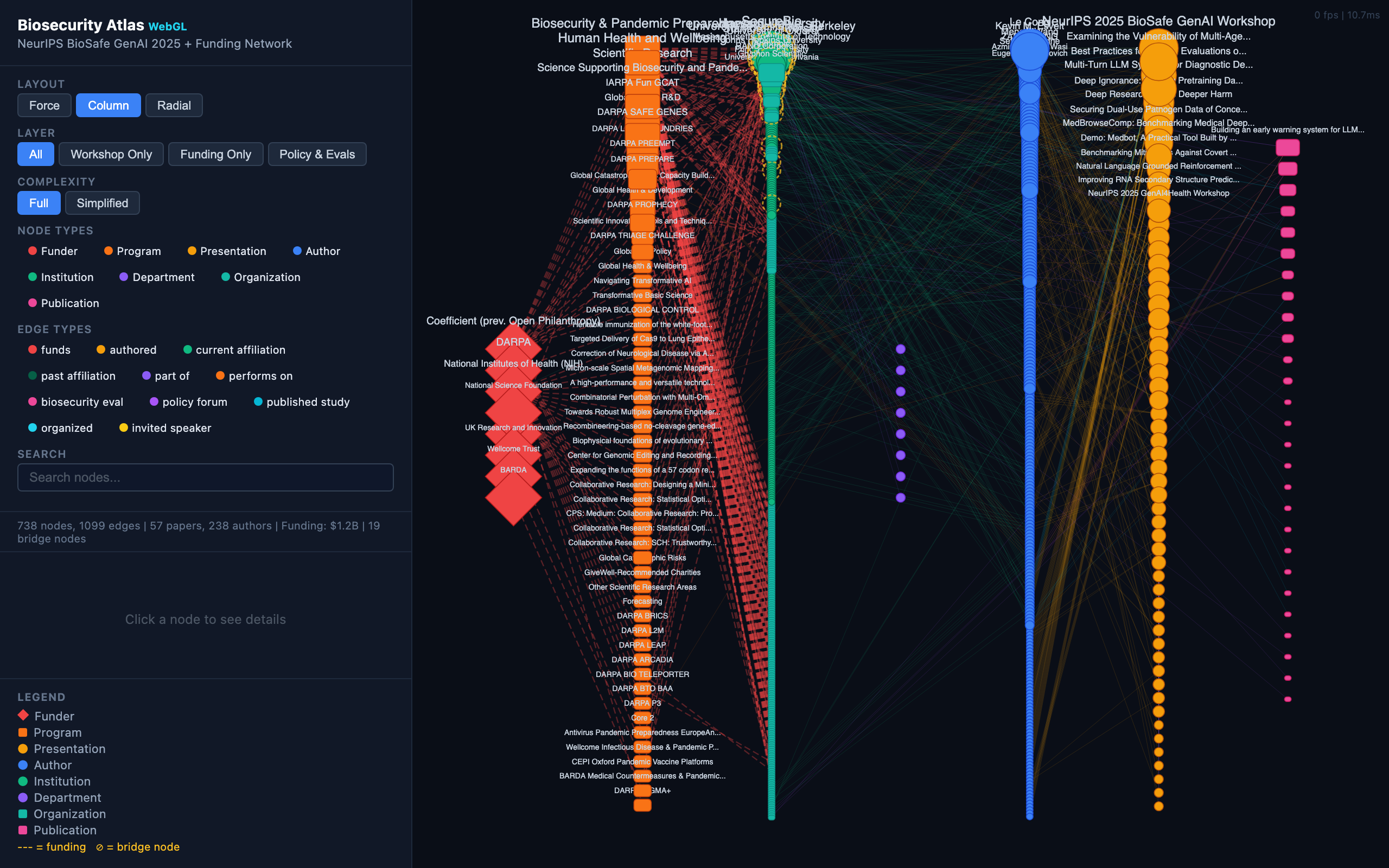
My first project built with Claude Code, made while I was getting curious about the intersection of biosafety and AI. It is a knowledge graph of the biosafety-and-AI research funding landscape, aggregated from five public funding and publication APIs, mapping who funds what and who is connected to whom in a field growing faster than its own directory. Reading that landscape is what pushed me toward my later work on the robustness of genomic foundation models.