
I keep building small games. Some take a single bioinformatics concept and make it playable — turning an idea into a toy is the fastest way I know to check whether I actually understand it, and a method you have to play is one you finally understand. Others have nothing to do with the bench; they are just what grad school looks like when you make a game out of it. All of them run in the browser.
Bioinformatics, made playable
I have lectured RNA-seq to rooms with no computational background, and each of these came out of wanting the idea to be something you do rather than something you are told.
Align Hero
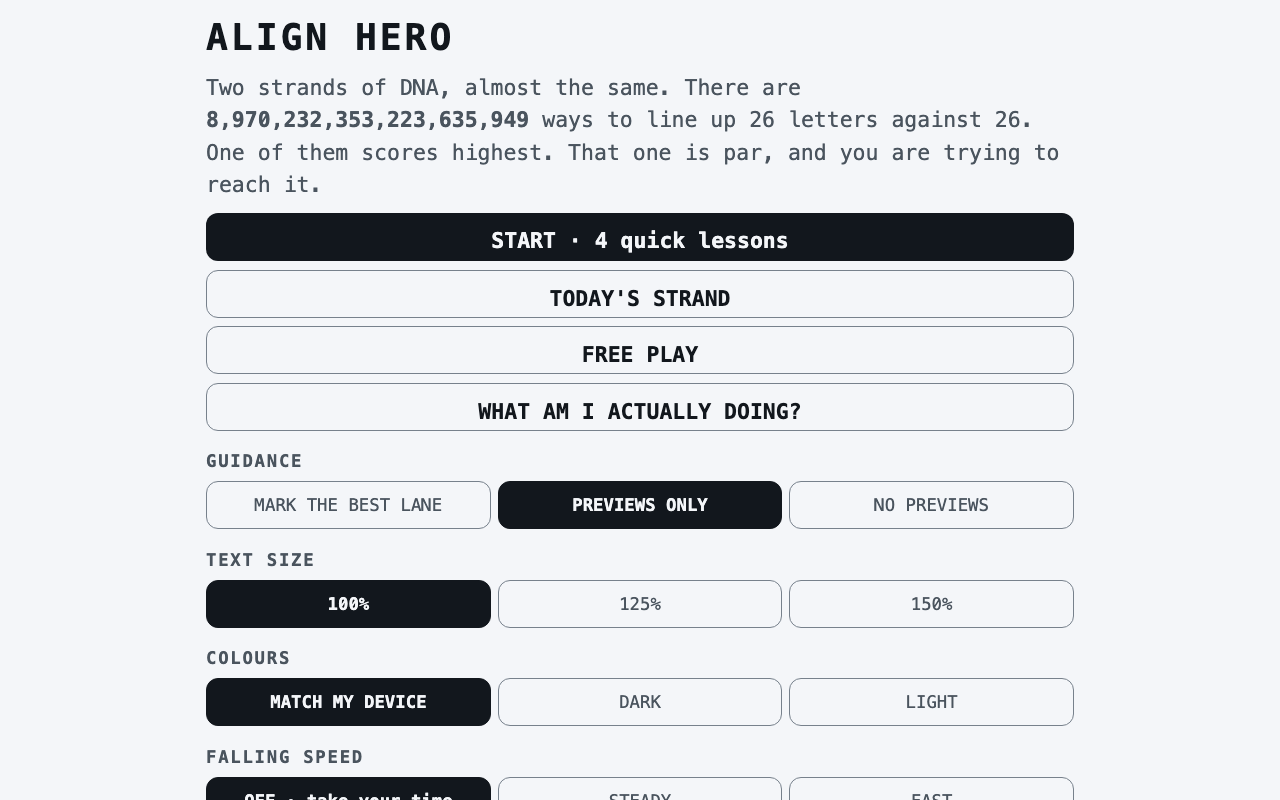
The Needleman–Wunsch alignment traceback as a rhythm game. Two strands of DNA, almost the same; there are 8,970,232,353,223,635,949 ways to line up 26 letters against 26, and exactly one scores highest — that one is par, and you are trying to reach it. Comes with four quick lessons and a “what am I actually doing?” button. Plays in a browser or a terminal.
Ribosome 2048
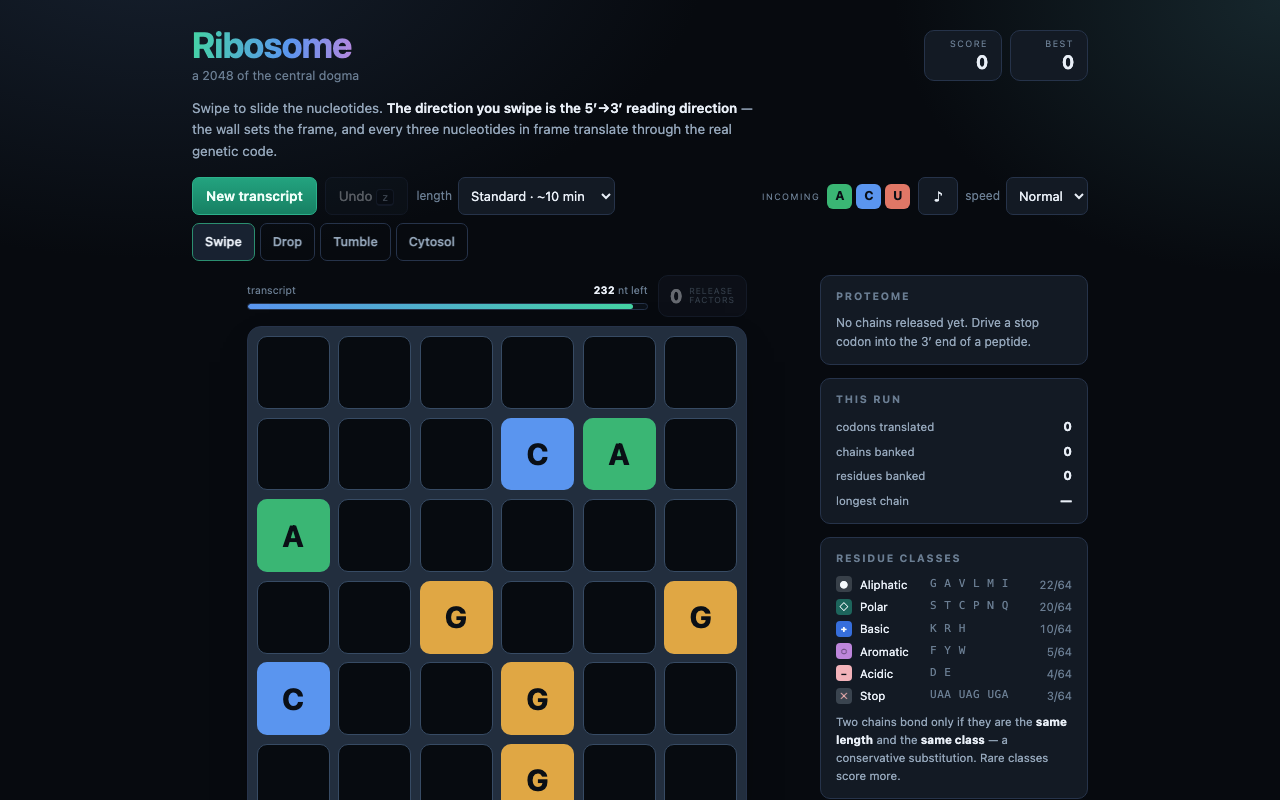
2048, but the central dogma. Slide nucleotides into the reading frame, translate codons, and build peptides — the merge rule is translation.
BioRedactle
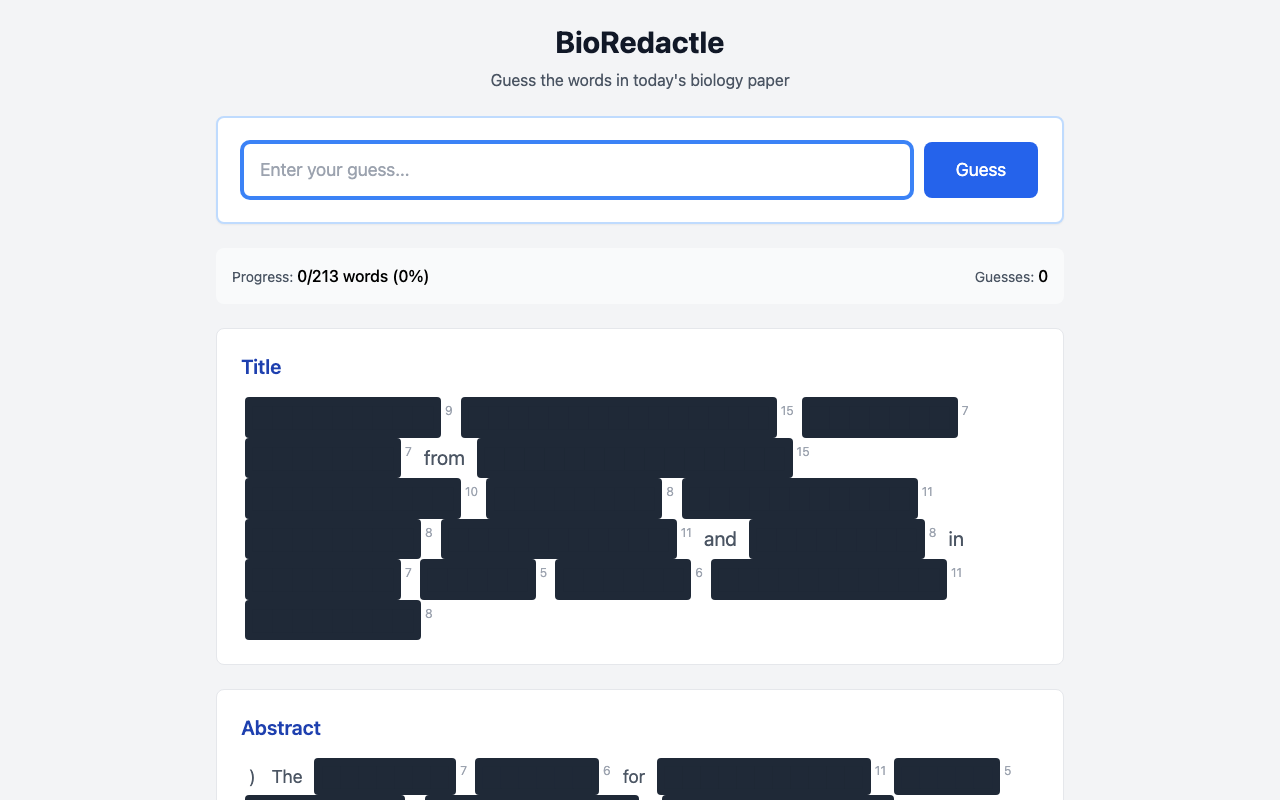
A daily Redactle on today’s biology paper: the title and abstract of a fresh open-access paper (PLOS by default, bioRxiv optional), redacted to word-length blocks. Guess words to un-redact it, and feel how much of a paper’s meaning rides on a handful of terms.
De Novo Gene Birth
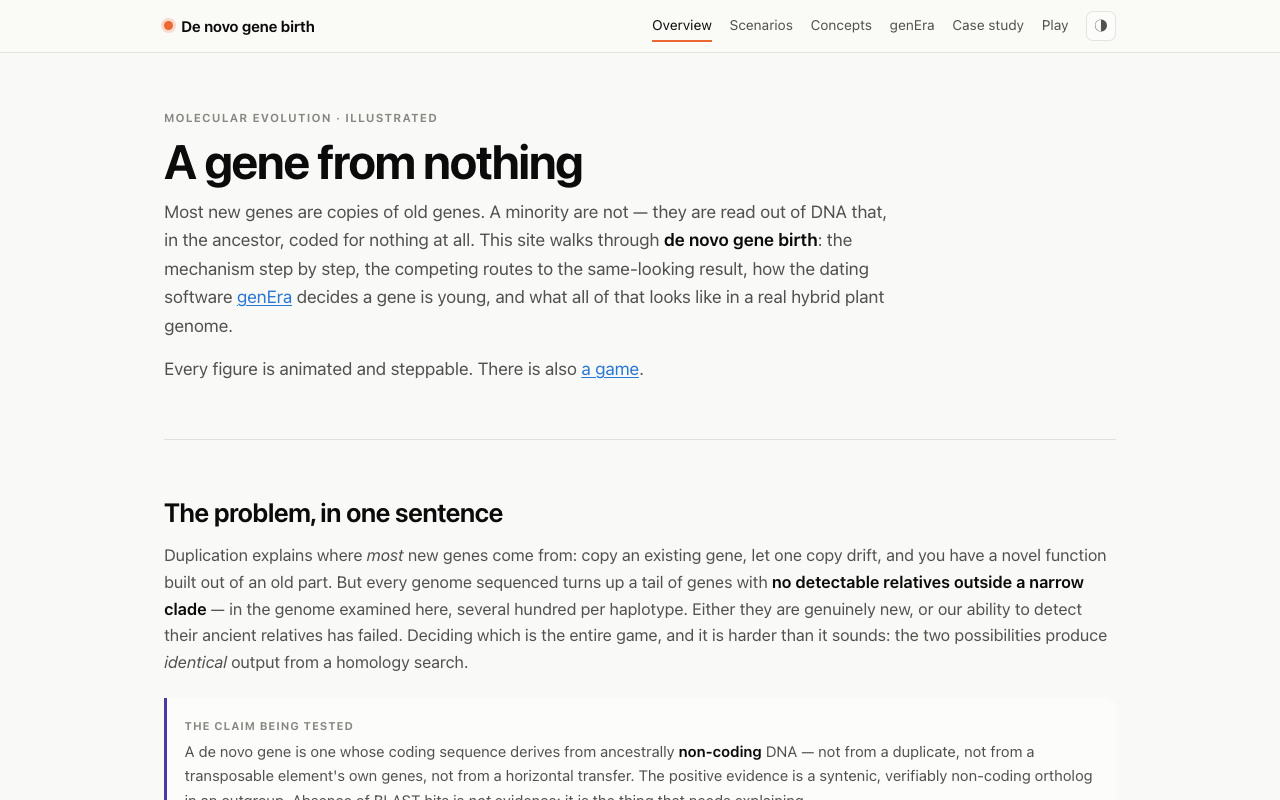
An animated explainer for de novo gene birth and genEra phylostratigraphy — how a gene can appear from non-coding sequence — paired with a QWOP-style game where you try to birth one. This one sits right next to my dissertation.
SILVA → MaAsLin2

An animated walk through the 16S amplicon chain — SILVA curation, QIIME 2 and DADA2, alpha- and beta-diversity, and MaAsLin — plus a pipeline-decision game. Built out of the CBCG metagenomics work I am doing this semester.
Beyond the bench
The ones that started as a way to laugh at grad school and turned into real games.
Glasshouse
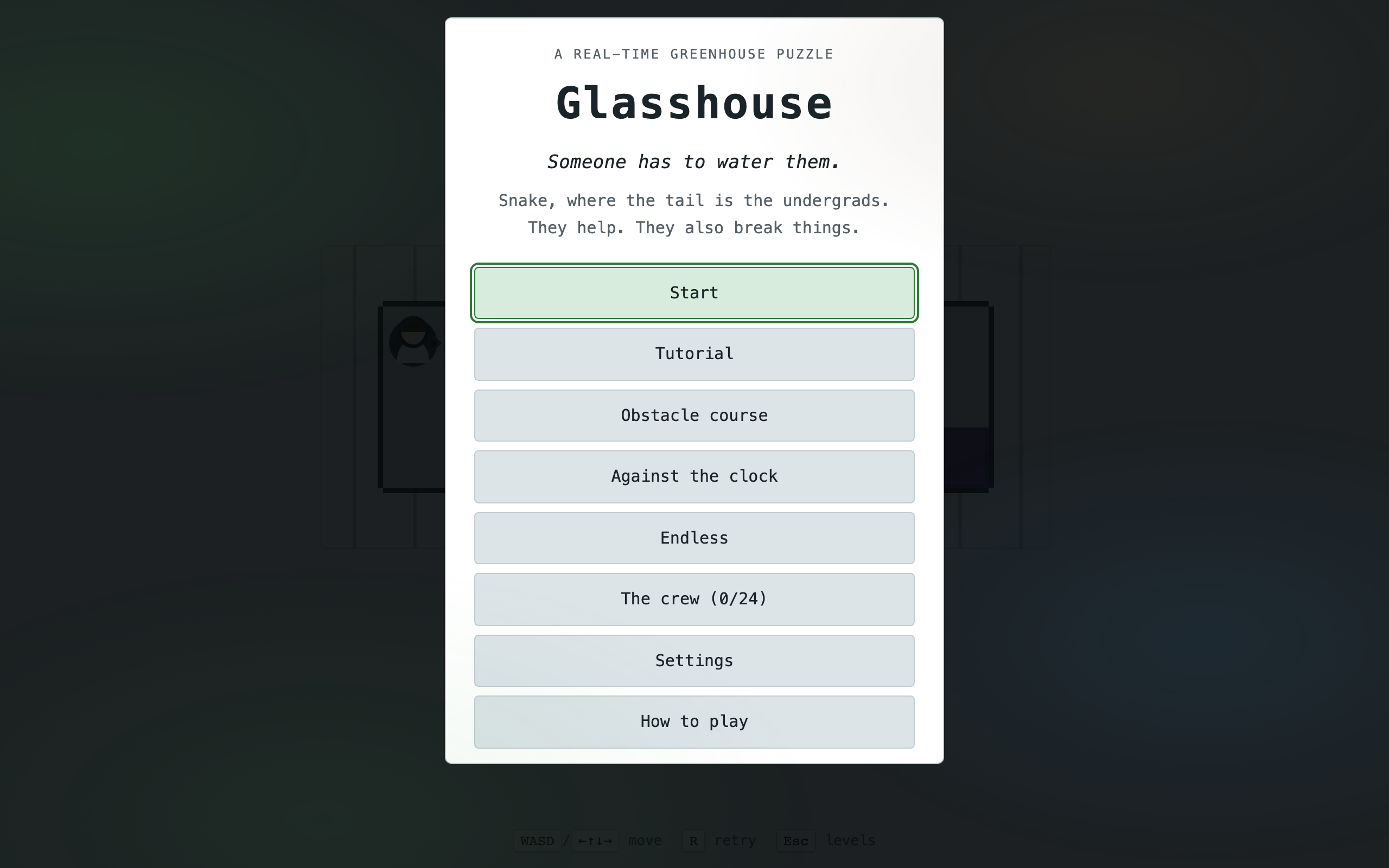
Snake has one rule at its center — you die if you touch your own tail — and that rule means nothing. It exists because it makes a good game, not because it points at anything true. Glasshouse is what happens when you give that rule a reason.
You are covering a research greenhouse on your own. Every tray of someone else’s unlogged samples you pick up puts another student in the line behind you, and now the tail is people. They follow single file, one more joins each time you collect something, and you genuinely cannot walk through them. Nothing about that had to be invented; it is just what covering a greenhouse alone feels like.
From there the rest of the game falls out of the metaphor. The line is not pure liability the way Snake’s tail is: anyone in it keeps a bench watered a little longer after you pass, so a longer line banks more care — but it costs you too, clipping benches and knocking three-year experiments onto the floor. The one release valve is to walk the whole load out the door; the students leave with it, and you start again on your own. It is still an early build — playable, with a tutorial, timed and endless modes, and a set of levels — but the core is there, and the core is the point: a mechanic that means something because it came from something real.
UGA Grad Survivor

A Reigns-style card game about surviving graduate school. Swipe left or right; every choice moves your advisor’s opinion, your funding, your sanity, and your progress. Built while doing the actual thing it simulates.
Triop
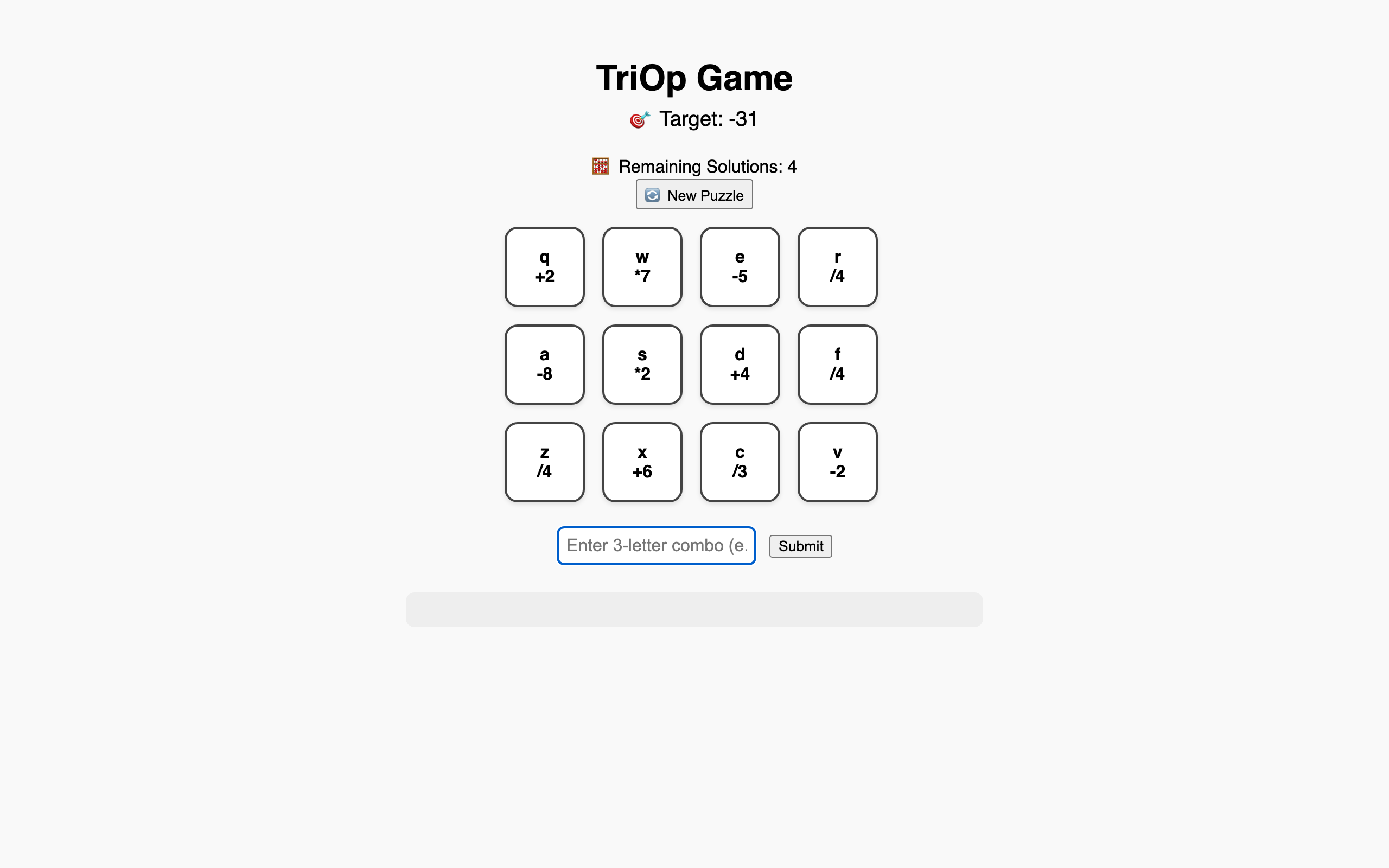
A solo math puzzle game — more a training system than a game — inspired by the number puzzles in The Devil’s Plan.